The books explored in this segment are really the reason I chose this topic in the first place! They are some of my favorite works for children, and it is a toss-up as to which wins the award for most adorable illustrations.
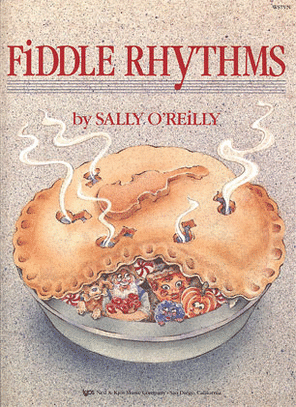
The first (chronologically) is Sally O'Reilly's Fiddle Rhythms (originally String Rhythms). For anyone unacquainted with Ms. O'Reilly, her official biography reads as follows: "Sally O'Reilly is known throughout the music world as a soloist, chamber musician, and pedagogue. Professor of Violin at the University of Minnesota School of Music in Minneapolis, she studied with Ivan Galamian at Curtis Institute and with Josef Gingold at Indiana University, where she was his assistant. Later she studied with Andre Gertler and Carlo Van Neste in Brussels, where she was a Fulbright Scholar. Her chamber music coaches included Janos Starker, Gyorgy Sebok, Artur Balsam, William Primrose, and Felix Galimir." (https://music.umn.edu/people/faculty-staff/profile?UID=oreil004)
While Ms. O'Reilly doesn't use specific lyrics throughout the book, she equates each rhythm with a mouth-watering pie filling as a clever mnemonic device. For example, "apple" (as in apple pie) represents two eighth-notes. Each rhythm has a page devoted to its exploration. First, the rhythm is used by itself to play "Twinkle Twinkle Little Star," and next reappears in a variation of this tune called "I Like _____ Pie." Then two or three short familiar tunes which use the rhythm put the cap on the lesson.
The first (chronologically) is Sally O'Reilly's Fiddle Rhythms (originally String Rhythms). For anyone unacquainted with Ms. O'Reilly, her official biography reads as follows: "Sally O'Reilly is known throughout the music world as a soloist, chamber musician, and pedagogue. Professor of Violin at the University of Minnesota School of Music in Minneapolis, she studied with Ivan Galamian at Curtis Institute and with Josef Gingold at Indiana University, where she was his assistant. Later she studied with Andre Gertler and Carlo Van Neste in Brussels, where she was a Fulbright Scholar. Her chamber music coaches included Janos Starker, Gyorgy Sebok, Artur Balsam, William Primrose, and Felix Galimir." (https://music.umn.edu/people/faculty-staff/profile?UID=oreil004)
While Ms. O'Reilly doesn't use specific lyrics throughout the book, she equates each rhythm with a mouth-watering pie filling as a clever mnemonic device. For example, "apple" (as in apple pie) represents two eighth-notes. Each rhythm has a page devoted to its exploration. First, the rhythm is used by itself to play "Twinkle Twinkle Little Star," and next reappears in a variation of this tune called "I Like _____ Pie." Then two or three short familiar tunes which use the rhythm put the cap on the lesson.
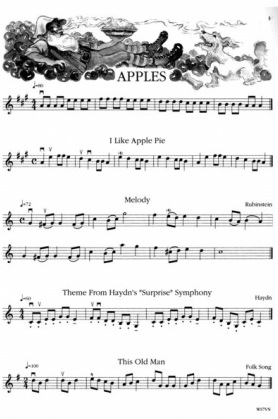
Ms. O'Reilly's pie fillings are often ingenious. "Orange" represents a sixteenth and dotted eighth (she is from Texas-- give it two syllables!), "banana" = 16th-8th-16th, "chocolate" is an eighth-note triplet, and so on. "Mixed fruit pies" are pages with tunes that combine the rhythms, and "Lopsided pies" use asymmetrical meters. A final page has a quiz on the different rhythm types, with the opportunity to compose a little. I love this book, even though it makes me want to head for the nearest diner for coffee and pie.
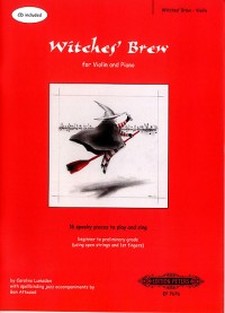
Next up are two of my all-time favorite books. They make me want to run out and lasso children to teach so I can have the joy of using them. Both are by British violinist and teacher Caroline Lumsden, author of the "Musicland" series, widely used in the UK. Ms. Lumsden studied at the Guildhall School of Music, and has spent much of her career specializing in teaching children. She is the director of the Beauchamp Music Group (named after her house), which is a registered charity that has taught hundreds of young people in Britain. Ms. Lumsden imbues her teaching with a great sense of fun, which is readily apparent in these two books.
The first, Witches' Brew, is a collection of pieces for open strings and first finger. Yawn, you say? Not with the collection of rhythms, bowings, special effects, jazzy accompaniments, and hilarious words (were you wondering when I'd get to that?) that comprise the music. Put out in 2002, the books got to ride in on the Harry Potter wave, but stand the test of time now that he's all grown up.
The first, Witches' Brew, is a collection of pieces for open strings and first finger. Yawn, you say? Not with the collection of rhythms, bowings, special effects, jazzy accompaniments, and hilarious words (were you wondering when I'd get to that?) that comprise the music. Put out in 2002, the books got to ride in on the Harry Potter wave, but stand the test of time now that he's all grown up.
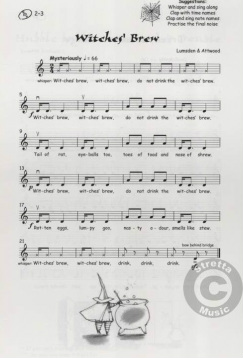
Each piece uses words to reinforce the rhythms, and the words all lie in that range of grossness that delights children so. The first of the tunes, "Witches' Brew" (pictured here; I don't know who stretta music is, but I can't think that they have any copyright claim to this), has the following lyrics:
Witches' brew, witches' brew
do not drink the witches' brew
Tail of rat, eyeballs too
toes of toad and nose of shrew.
Witches' brew, witches' brew
do not drink the witches' brew
Rotten eggs, lumpy goo
nasty odor, smells like stew.
Witches' brew, witches' brew
drink drink drink
Practice suggestions at the top read:
Whisper and sing along; Clap with time names; Clap and sing note names; Practice the final noise.
Witches' brew, witches' brew
do not drink the witches' brew
Tail of rat, eyeballs too
toes of toad and nose of shrew.
Witches' brew, witches' brew
do not drink the witches' brew
Rotten eggs, lumpy goo
nasty odor, smells like stew.
Witches' brew, witches' brew
drink drink drink
Practice suggestions at the top read:
Whisper and sing along; Clap with time names; Clap and sing note names; Practice the final noise.
The book comes with a cd which includes both performance and accompaniment tracks for each piece. Here is "Witches' Brew":
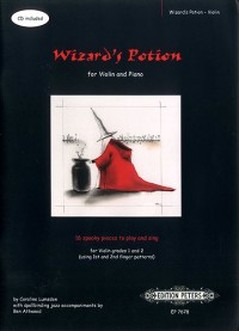
The second volume, Wizard's Potion, continues the fun with "16 spooky pieces to play and sing." Like the first, it includes a cd, adorable illustrations, and a summary of teaching points for each piece in the piano part. This time the player's range is extended to first and second finger patterns, and chromatic alterations are common. Children are weaned away from the reliance on words to learn rhythms, with only the first five pieces including lyrics. However, the "rhythm" of the title is generally found in the first measure or two of the violin part. One of my favorites, "Melted Mouse & Roasted Rat in Choc'late Sauce," comes off as a delightfully dirty blues. Just to imagine a little cherub getting down and swinging away on this makes me start looking around for younger students again...
I am a huge fan of Ms. Lumsden, if you couldn't tell. Both books are published by Peters, and are also available in a version for cello. Word use is certainly more fun in her hands than it was a century ago!
I am a huge fan of Ms. Lumsden, if you couldn't tell. Both books are published by Peters, and are also available in a version for cello. Word use is certainly more fun in her hands than it was a century ago!
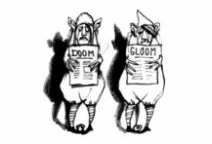
One final note (and chance to show you another adorable illustration from Wizard's Potion): The covers and illustrations were found online and are used without permission. Ditto with the sound files, which are from the cd's that come with the book. I use them all only with the intent to introduce this wonderful material to others and to sell lots of copies for Ms. O'Reilly and Ms. Lumsden. Hopefully that will keep me out of trouble!
 RSS Feed