Violin Music by Women: A Graded Anthology
  • Home
  • Order here!
  • Violin Anthology Contents
  • Violin Sound Files
  • VIOLA MUSIC BY WOMEN
  • Viola Sound Files
  • Blog
  • More music to explore
  • About the editor

Words and Music, Part Two

2/21/2013

0 Comments

 
Picture
The books explored in this segment are really the reason I chose this topic in the first place! They are some of my favorite works for children, and it is a toss-up as to which wins the award for most adorable illustrations.

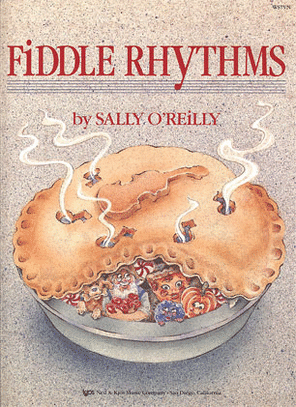
The first (chronologically) is Sally O'Reilly's Fiddle Rhythms (originally String Rhythms). For anyone unacquainted with Ms. O'Reilly, her official biography reads as follows: "Sally O'Reilly is known throughout the music world as a soloist, chamber musician, and pedagogue. Professor of Violin at the University of Minnesota School of Music in Minneapolis, she studied with Ivan Galamian at Curtis Institute and with Josef Gingold at Indiana University, where she was his assistant. Later she studied with Andre Gertler and Carlo Van Neste in Brussels, where she was a Fulbright Scholar. Her chamber music coaches included Janos Starker, Gyorgy Sebok, Artur Balsam, William Primrose, and Felix Galimir." (https://music.umn.edu/people/faculty-staff/profile?UID=oreil004) 

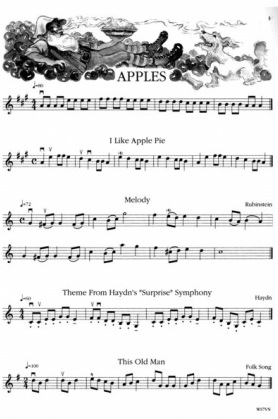
While Ms. O'Reilly doesn't use specific lyrics throughout the book, she equates each rhythm with a mouth-watering pie filling as a clever mnemonic device. For example, "apple" (as in apple pie) represents two eighth-notes. Each rhythm has a page devoted to its exploration. First, the rhythm is used by itself to play "Twinkle Twinkle Little Star," and next reappears in a variation of this tune called "I Like _____ Pie." Then two or three short familiar tunes which use the rhythm put the cap on the lesson.
Picture
Ms. O'Reilly's pie fillings are often ingenious. "Orange" represents a sixteenth and dotted eighth (she is from Texas-- give it two syllables!), "banana" = 16th-8th-16th, "chocolate" is an eighth-note triplet, and so on. "Mixed fruit pies" are pages with tunes that combine the rhythms, and "Lopsided pies" use asymmetrical meters. A final page has a quiz on the different rhythm types, with the opportunity to compose a little. I love this book, even though it makes me want to head for the nearest diner for coffee and pie.
Picture
Next up are two of my all-time favorite books. They make me want to run out and lasso children to teach so I can have the joy of using them. Both are by British violinist and teacher Caroline Lumsden, author of the "Musicland" series, widely used in the UK. Ms. Lumsden studied at the Guildhall School of Music, and has spent much of her career specializing in teaching children. She is the director of the Beauchamp Music Group (named after her house), which is a registered charity that has taught hundreds of young people in Britain. Ms. Lumsden imbues her teaching with a great sense of fun, which is readily apparent in these two books. 

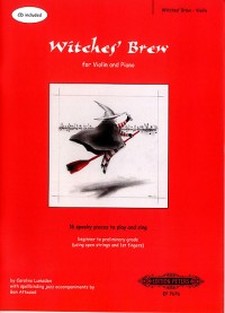
The first, Witches' Brew, is a collection of pieces for open strings and first finger. Yawn, you say? Not with the collection of rhythms, bowings, special effects, jazzy accompaniments, and hilarious words (were you wondering when I'd get to that?) that comprise the music. Put out in 2002, the books got to ride in on the Harry Potter wave, but stand the test of time now that he's all grown up.
Picture
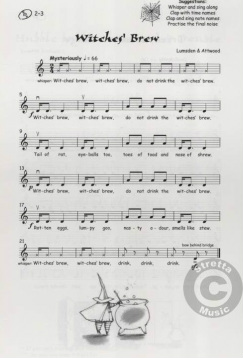
Each piece uses words to reinforce the rhythms, and the words  all lie in that range of grossness that delights children so. The first of the tunes, "Witches' Brew" (pictured here; I don't know who stretta music is, but I can't think that they have any copyright claim to this), has the following lyrics:

Witches' brew, witches' brew
do not drink the witches' brew
Tail of rat, eyeballs too
toes of toad and nose of shrew.

Witches' brew, witches' brew
do not drink the witches' brew
Rotten eggs, lumpy goo
nasty odor, smells like stew.

Witches' brew, witches' brew
drink drink drink


Practice suggestions at the top read: 
Whisper and sing along; Clap with time names; Clap and sing note names; Practice the final noise.

The book comes with a cd which includes both performance and accompaniment tracks for each piece. Here is "Witches' Brew":
Picture
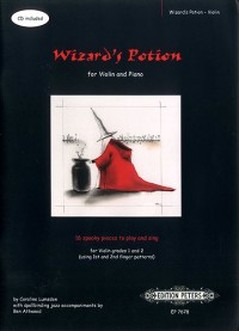
The second volume, Wizard's Potion, continues the fun with "16 spooky pieces to play and sing." Like the first, it includes a cd, adorable illustrations, and a summary of teaching points for each piece in the piano part. This time the player's range is extended to first and second finger patterns, and chromatic alterations are common. Children are weaned away from the reliance on words to learn rhythms, with only the first five pieces including lyrics. However, the "rhythm" of the title is generally found in the first measure or two of the violin part. One of my favorites, "Melted Mouse & Roasted Rat in Choc'late Sauce," comes off as a delightfully dirty blues. Just to imagine a little cherub getting down and swinging away on this makes me start looking around for younger students again...

I am a huge fan of Ms. Lumsden, if you couldn't tell. Both books are published by Peters, and are also available in a version for cello. Word use is certainly more fun in her hands than it was a century ago!
Picture

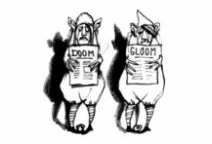
One final note (and chance to show you another adorable illustration from Wizard's Potion): The covers and illustrations were found online and are used without permission. Ditto with the sound files, which are from the cd's that come with the book. I use them all only with the intent to introduce this wonderful material to others and to sell lots of copies for Ms. O'Reilly and Ms. Lumsden. Hopefully that will keep me out of trouble!  
0 Comments

'Tis the Season: Rebecca Clarke's "Combined Carols"

12/17/2012

3 Comments

 
Whether you are frantically searching for a new holiday piece for gigs, or calmly planning next year's festivities, the good people at Prairie Dawg Press have just the right thing for you. They have recently published (for the first time ever) Clarke's Combined Carols in both string quartet and string orchestra versions. The work's subtitle is "Get 'em all over at once," and in it she combines three popular carols contrapuntally: "God Rest Ye Merry, Gentlemen," "Oh Come, All Ye Faithful," and "Silent Night." Originally written in 1942 for family members to play as a quartet, Clarke later added a bass part to create the string orchestra version. According to Clarke's musical executor, Christopher Johnson, the piece also became a yearly staple at the Oxford University Press holiday party. Head on over to www.prairiedawgpress.com to order your copy! 

If the name Rebecca Clarke is unknown to you, this tells me that 1) you are not a violist and 2) you have some glorious musical discoveries ahead of you. Christopher Johnson has been kind enough to supply the following biographical sketch:

"Born to a musical family in Harrow, England, in 1886, Rebecca Clarke learned the violin at an early age, and then went to the Royal Academy of Music, London, for further study.  In 1908, she was accepted as Sir 
Charles Stanford’s first female composition student, and entered the Royal College of Music.  Stanford urged her to shift over to the viola because then she would be “right in the middle of the sound, and can 
tell how it’s all done.”

Two years later, when family turmoil forced her to leave the College, she began to support herself as a violist, and soon became a much-sought-after supply player in orchestras and ensembles around London.  In 1912, Sir Henry Wood hired her to play in his Queen’s Hall Orchestra, making her one of the first women to become regular members of a professional orchestra in London.  She played chamber music with many of the greatest artists of the twentieth century, including Schnabel, Casals, Thibaud, Suggia, Rubinstein, Grainger, Hess, and Szell.

Billing herself “Rebecca Clarke, viola player and composer,” she became a fixture of recital halls in England and the United States, gave a concert of her own works at the Wigmore Hall, London, and made an 
around-the-world tour.  In 1919, she wrote one of the greatest extended works for viola: her Sonata, which tied with the Bloch Suite in an anonymous competition sponsored by the American patroness Elizabeth 
Sprague Coolidge.  The Sonata was published in 1921 and rapidly became a cornerstone of the viola literature.  Many of Clarke’s finest songs and chamber works, including her now-classic Piano Trio, were in print by 1930.

Clarke’s output was numerically small—about eighty pieces, excluding early amateur efforts—but its power, brilliance, and poetic depth were widely acknowledged, and as early as 1920 Clarke's name and compositions began to appear in British, American, and European reference-works.  As a performer, she remained a familiar presence in concert halls and recording studios, both in London and in New York, but her composing was disrupted by a painful love-affair in the 1930s, and again by World War II.  With the postwar triumph of serialism, her essentially tonal idiom began to seem "old hat," as she put it, and her published works gradually went out of print.

By the 1970s, however, with tonality making a comeback and the women’s movement stirring up new interest in female composers, Clarke was ideally positioned for a revival.  She allowed her works to be cataloged, and set about revising many of them.  By the time she died in 1979, she had had several major New York performances and had taken part in an extended radio broadcast honoring her ninetieth birthday. The following year saw the first in what became a spate of commercial recordings.  Virtually all of her mature compositions have now been either published, or recorded, or both, and many have become mainstays 
of the concert and recital repertoires."

You can find the slow movement of Clarke's violin sonata, written when she was studying with Stanford, in the fourth volume of the anthology. The sonata, as well as some other works by Clarke, has been recorded by Lorraine McAslan. The full piece will be published by Prairie Dawg Press in the near future.

Happy holidays!
3 Comments

The "Babe-ification" of Women in Classical Music, Part 3

10/23/2012

0 Comments

 
Frederique Petrides, conductor of the Orchestrette Classique (a New York women’s orchestra), published many examples of the hostility women faced in her 1930's newsletter, Women in Music. According to the September 1938 newsletter:

“A feud between Parisian men and women musicians was reported a few weeks ago by Transradio Press in one of its daily Women Make the News broadcasts... According to this source, the discord is “all due to the fact that women’s orchestras are now so popular (in the French capital) that some of the men musicians are having a tough time getting work in night clubs and cafes. The feud reached such a height recently that 16 police guards had to be called out to quell a riot. They found a young woman violinist holding a crowd of men, and using her violin case as a weapon of defense. The violinist, Estelle Francen, had just arrived at an assembly hall in Montmartre where hopeful musicians gather for bookings. A group of men musicians spied her and an angry shout rang out: ‘There is one of them!’ The men looked so threatening that Miss Francen turned and ran. They pursued her until she sought refuge in a subway entrance. For 20 minutes, she kept the men musicians back as she slashed vigorously with her violin case. The 16 gendarmes arrived just in time to save the girl musician from the angry mob of jobless men musicians.”

The issue of physical appearance, this time with a twist, is used in conjunction with economics in this quote from the December 1938 newsletter:

“Quoted from Musical Leader is an article concerning discrimination against women orchestral players by leading conductors who cannot throw tradition to the winds. But there is something more than tradition that prevents major orchestras from employing women. Lady patrons of symphony concerts are in the large majority. They go to symphony concerts to see an orchestra of men. There would be a big slump in attendance if the orchestra became a mixed affair. A woman’s symphony orchestra is a specific organization. A man’s orchestra should be manned by men, because this is the only way it can be maintained.”

Some of Petrides’s reports show that the prejudice against women in orchestras stemmed from a rather misguided form of chivalry. For example, these two excerpts from July 1937 and January 1938:

[from Wm. J. Henderson, NY music critic] “There is no good reason why women should not be employed in orchestras. The chief question to be asked is whether they can play as well as men. After that, other considerations may be taken up. Can a conductor enforce discipline among the women as well as he can among the men, or will they have recourse to tears when the hard-hearted one addresses the instrumental body in merciless rebuke? Can women endure the severe strain of long and repeated rehearsals?”

[Richard Czerwonky, Musical Observer] “Women orchestra players are not popular with conductors, mainly because the conductors do not feel at liberty to swear as occasion demands before them, as they do before a lot of men. A conductor, in the stress of rehearsal, cannot stop and delete his favorite remarks when things are not going so well, just because there are ladies present... No man who is a gentleman can [swear] without the instinct of apology when there are women around– and that is the main reason why women are not popular as members of symphony orchestras.”

Nevertheless, professional women musicians continued to increase in numbers, though even where accepted, they had a treacherous path to tread. The regard for modesty and beauty had never completely vanished, but presented new pitfalls in the modern era. Again from the Women in Music newsletter, April 1939:

[Paul Denis, Billboard NY editor] “Many are the problems confronting girl musicians in the popular music field. Girl dance band musicians must not smile at patrons, because they, the girls, may be misunderstood. They must not engage in friendly banter with male patrons near the bandstand because the women patrons may suspect that the girl musicians are trying to steal their men. The girl musicians must be dressed attractively but not flashily – so that they will impress as musicians and not as flirts. The leader of the girl band must be careful, too. She must be genial, and more attractive than the rest of the orchestra – but she, too, must be careful not to appear to be flirting with male patrons. Because of this situation, many high class hotels are afraid to book girl dance bands...”

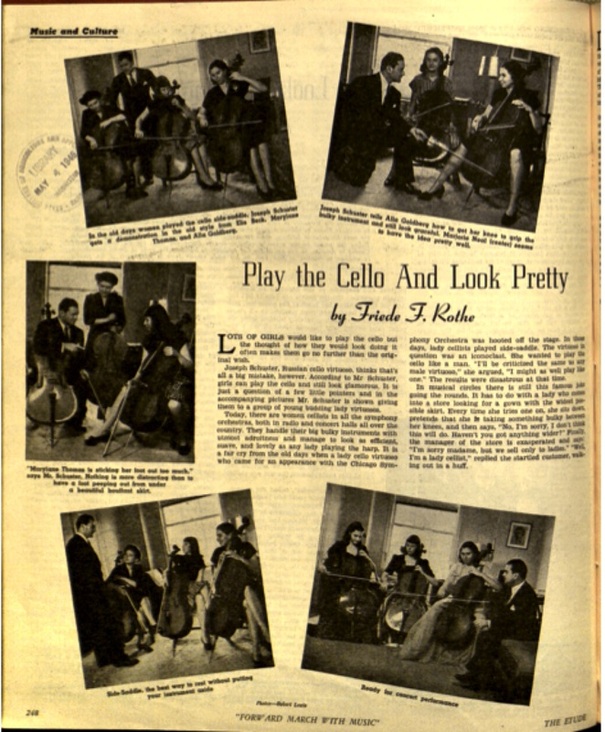
Many articles appeared in the 1940's and 50's that, while appearing to be supportive of women instrumentalists, still reinforced many clichés and placed a disproportionate emphasis on appearance. This image, from the May 1946 issue of Etude Magazine, illustrates this well: 
Picture
The first sentence reads, "Lots of girls would like to play the cello but the thought of how they would look doing it often makes them go no further than the original wish." Isn't it nice that this man can fix it for these women? I particularly like the caption for the second picture on the left: "'Maryjane Thomas is sticking her foot out too much,' says Mr. Schuster. Nothing is more distracting than to have a foot peeping out from under a beautiful bouffant skirt." And the last paragraph of the article is telling: "In musical circles there is still this famous joke going the rounds. It has to do with a lady who enters into a store looking for a gown with the widest possible skirt. Every time she tries one on, she sits down, pretends she is taking something bulky between her knees, and then says, 'No, I'm sorry, I don't think this will do. Haven't you got anything wider?' Finally, the manager of the store is exasperated and says, 'I'm sorry madame, but we sell only to ladies.' 'Well, I'm a lady cellist,' replied the startled customer, walking out in a huff." 

Ha. Ha. Ha.  

last installment to come!
0 Comments

The "Babe-ification" of Women in Classical Music, Part 1

9/23/2012

3 Comments

 
Picture
The next few posts will be a serialization of a paper I wrote back in the dim recesses of memory (meaning 1999), and presented at the Feminist Music and Theory V conference in London, England. It seems to me the main changes since then are the increasing "babe-ification" of men (google Charlie Siem, for an example)... I suppose that's a kind of progress?

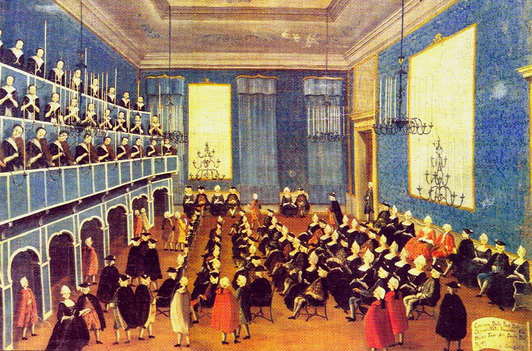
Two hundred years ago, the female musicians of the Venetian ospedali could be heard but not seen, sheltered from view as they performed. Today it seems that the music industry has decided that women musicians must be seen– and often a great deal of the woman’s body must be seen– before she will be heard; that is, before her recording will be marketed or purchased. Why is it that a woman’s appearance, whether judged as suitable or unsuitable, continually captures the attention of the musical establishment? Have we really progressed so far beyond the attitudes towards those ospedali students, or is this merely the other side of the same coin?

This paper had its genesis about five years ago, from what at first seemed to me an innocuous observation. While browsing through violin recordings (my particular interest), I began noticing an increasing number of “cheesecake” photos on cd covers. Delighted as I am to note the upsurge of talented young women violinists, it did strike my middle-aged and chubby self that perhaps the already tough criteria for success as a Classical musician was getting tougher– if you were female, you’d better be a “babe.”

What a mystery! A recording is an aural, not a visual experience– if the musician is accomplished, why should we care about his or her form? As I began to look at the perception of women musicians it became clear that, in one way or another, their appearance has always been as significant as their skill in the public’s eye and mind.

Perception-- what we appear to be and what others wish we would appear to be. The perception of proper feminine roles has always been a major issue for women in music. Those roles have perhaps been debated with the greatest heat in regard to women as composers. While these women were not actively in the limelight like performers, their “womanliness” (which, of course, would be reflected in their appearance) was nonetheless of great interest to the public. To quote Christine Ammer in her book Unsung: “If... a woman should produce a respectable composition, it was argued that she could do so only at the expense of her ‘womanhood.’ For example, one writer pointed out that, even if matrimony and lack of strength and endurance did not deter a woman composer, it still took a considerable amount of ‘fight’ to make one’s way. Even many men found themselves temperamentally ill equipped for such battle. And if a woman should be suited for it, it would diminish her ‘womanly qualities,’ and then what would become of her power of writing ‘womanly music?’”

So many Catch-22's! Writers often worked hard to assure their readers that these risqué women composers had not lost this mysterious “womanliness” by virtue of their musical pursuits. Here, for example, the introduction to an article from the February 1904 issue of Etude Magazine interviewing Amy Beach:

“When Mr. George Whitfield Chadwick first heard Mrs. Beach’s symphony, he is said to have exclaimed, ‘Why was I not born a woman?’ It was the delicacy of thought and finish in her musical expression that had struck him, an expression of true womanliness, absolute in its sincerity... She is a woman of charmingly simple manners, and, as foregone conclusion, of high, innate refinement. She is of medium height. Her eyes are of a grayish blue, large, and smiling. Her complexion is fresh and brilliant... Her straightforwardness is like her personality– gentle, direct, convincing... If you should put direct questions to her as I did you would learn that she composes when she feels the inclination move her to it; that she studies the piano when she is not writing; that one time of day is as good to work in as another, and that her housekeeping is of a very earnest interest to her. This last, however, was an admission, not an answer; but there was such ample proof of it that it must be put down. So many great ladies in art have told me what good housekeepers they were, and, after leaving them, I have had to stop, on turning the first shielding corner, to brush from my overcoat the veneer of dust it had acquired on their hall bench. Mrs. Beach’s domestic regime is not of this type. It fills you with chagrin, indeed, not at the prospect of dust carried out, but at the fearful possibilities of dust carried in.”

The double standard becomes so clear when we turn the tables and apply the same treatment to men! The brilliant mystery writer Dorothy L. Sayers does just that in a collection of essays from the 1930's, entitled Are Women Human?

“Probably no man has ever troubled to imagine how strange his life would appear to himself if it were unrelentingly assessed in terms of his maleness; if everything he wore, said or did had to be justified by reference to female approval; if he were compelled to regard himself, day in and day out, not as a member of society, but merely as a virile member of society... If he were vexed by continual advice how to add a rough male tough to his typing, how to be learned without losing his masculine appeal, how to combine chemical research with seduction, how to play bridge without incurring the suspicion of impotence... He would be edified by solemn discussions about ‘Should Men Serve in Drapery Establishments?’ and acrimonious ones about ‘Tea-Drinking Men’; by cross-shots of public affairs ‘from the masculine angle,’ and by irritable correspondence about men who expose their anatomy on beaches (so masculine of them), conceal it in dressing-gowns (so feminine of them), think about nothing but women, pretend an unnatural indifference to women, exploit their sex to get jobs, lower the tone of the office by their sexless appearance, and generally fail to please a public opinion which demands the incompatible... If he gave an interview to a reporter, or performed any unusual exploit, he would find it recorded in such terms as these: ‘Professor Bract, although a distinguished botanist, is not in any way an unmanly man. He has, in fact, a wife and seven children. Tall and burly, the hands with which he handles his delicate specimens are as gnarled and powerful as those of a Canadian lumberjack, and when I swilled beer with him in his laboratory, he bawled his conclusions at me in a voice that implemented the promise of his swaggering moustache.’”

A recurring theme in Ms. Sayers 1936 novel, Gaudy Night, is the importance of finding one’s “job” in life, and remaining faithful to it, no matter the outside opinion. Interesting to hear this sentiment echoed two years later by Nadia Boulanger, when asked by a reporter how it felt to be the first woman to ever conduct the Boston Symphony: “I’ve been a woman for a little over fifty years, and have gotten over my initial astonishment. As for conducting an orchestra, that’s a job. I don’t think sex plays much part.”

Alas, this clarity of vision seems all too rare. 


stay tuned for more...

3 Comments

Two Unsung Heroes: Harvey S. Whistler and Arthur P. Schmidt

8/26/2012

4 Comments

 
As I was researching music for inclusion in the anthology, two trends caught my attention. When music came via interlibrary loan, more often than not it came from the "Harvey Whistler Memorial Collection" at Arizona State University. And often, the music had been published by the Arthur P. Schmidt Publishing Company. 

Unsung Hero #1: Harvey S. Whistler

Of course, as a violin teacher I have used Whistler's Introducing the Positions and Preparing for Kreutzer for years and have always admired his pedagogical acuity. Just like Josephine Trott, I realized I knew nothing about him. Fortunately, my colleague down the road at the University of Kansas, Dr. Jacob Dakon, has done the research for me this time. The information below is all taken from Jacob's article, "Dr. Harvey Samuel Whistler Jr. (1907-1976): an influential pedagogue and researcher in music education," published in the Journal of Historical Research in Music Education (Oct. 1, 2011) and accessed via HighBeam Research (www.highbeam.com).

Whistler grew up in California, mainly in Fresno. He studied piano with his mother, then by age seven began violin and piano studies outside the home. Piano fell by the wayside, and Harvey passed through a number of violin teachers. He was clearly a fine violinist by the time he graduated from high school, publicly performing Paganini's Le Streghe and Sarasate's Zigeunerweisen. He went on to study at Fresno State Teacher's College, the earned a master of science in education from USC. Whistler received his doctorate in music education from the Ohio State University in 1942.  

According to Dakon, Whistler "spent the majority of his early professional life (1925-1939) as an instrumental class instructor." He worked with all levels of students, both string and wind. In addition to his music publications, Whistler was also a prolific writer/ journalist (as was Josephine Trott!) for publications such as Musical West magazine, the Fresno Morning Republican newspaper, and The Reflector magazine. While still teaching at Selma-Union High School, Whistler began his impressive publishing record. He was hired by Rubank in 1939 as a "full-time composer, arranger and editor," and would publish "more than 150 works and collections for both solo instruments and ensembles to be used in the private studio and the classroom." Dakon writes that nearly one-third of these books are still in print and available in the Hal Leonard Publishing Company catalogue.

Dakon characterizes Whistler's works as "retrospectively formatted"-- in other words, he took older materials for a single instrument and reworked them to fit a class situation. In this case, the materials are largely violin etudes from the eighteenth- and nineteenth-century. Some of the "reworking" has disturbed me over the years, as when etudes I knew from Kayser or the like were re-composed for Preparing for Kreutzer. By doing this, Whistler maintained etudes of one page in length, whether he had to hack out sections or add on at the end to make it so. That consistency of length does make gauging the students'  workload when assigning material much easier!

After serving in the military in World War II, Whistler spent much time in the 1950's collaborating with Dr. Louis P. Thorpe of USC. They explored and published articles on subjects dear to music education: musical aptitude, testing for musical talent, and memorization. A co-authored textbook on the psychology of music was never finished.

By the 1960's, Whistler began pulling away from working life and devoting more time to the study of antiquities. He focused in particular on violin bows, and began a comprehensive dictionary  entitled "Bow Makers of the World: A Critical and Historical Encyclopedic Dictionary." From this work came three articles on major bow makers Tourte, Peccatte, and Kittel, and a co-authored book on Vuillaume. Before his death, Whistler had completed at least 1200 biographical entries in his bow maker's dictionary, but bemoaned the fact that he had at least 1000 more to go.

Dakon makes an excellent summation of Whistler's importance in the field of music education: "Ultimately, it is trivial to argue over how influential one technique book or or research project is over another. What matters is that Whistler sought to enhance music education by developing a wide variety of materials for music teachers and students to use in the class and studio. Furthermore, he sought to understand and report the current state of music education through his research so the field could continue to develop. Whistler helped to propagate band and string education throughout the twentieth century; he continues to do so nearly three and a half decades after his death. For this reason alone, Whistler made a significant impact in music education and should, therefore, be considered an influential figure in its history." No argument here!

Somehow (and I will try to find out how), Whistler's vast personal collection of violin music came to be housed in a special collection at Arizona State. A field trip is definitely in my future! His holdings were diverse and featured, as I have noted, many, many works by women composers and pedagogues. And many of those were published by the A. P. Schmidt Company...
4 Comments

Kemp Stillings: The Finale!

7/17/2012

0 Comments

 
Well, sorry about the wait... but I had a great vacation! For the finale here, I want to tell you about the three publications I've found by Kemp Stillings. There were hints of more in the newspaper articles, but these are the only ones I've located.

The first, from 1926, is called The Great Adventure. The cover depicts a stern king (who looks a lot like a king in a deck of playing cards) enthroned in the upper right corner of the page, while down in the lower left corner a little boy holding a violin case looks up at him, no doubt with trepidation. The caption on bottom right reads, "'Why didn't you come sooner?' said the Violin King." Gulp! Yet this whole book is an attempt to humanize the process of learning the basics of playing the violin. In a preface "to the grown-ups," Stilling writes:
          Remembering my own childhood days and also recalling how completely the tremendous
          enthusiasm with which I had commenced my violin studies vanished after the first few
          lessons, for many years never to return; Remembering this most vividly, I have endeavored
          to surround the tedious work of laying a firm foundation with enough of imaginative
          glamour to make it attractive to the childish mind.
Stillings then goes on to write the story of Jules, who has longed to meet the Violin King but could not find a proper guide. Having found one "who knew the way well," the author and Jules set out on their journey through rhythmic notation, counting, open strings, and all four fingers. There are delightful illustrations by V. (Vera?) Somoff throughout, and quite a few duets to keep things interesting.

The next book arrived two years later. Entitled The Giant Talks, it continues the story of Jules on his quest for violin mastery. This cover features a giant, the somewhat hapless Jules, and a pile of boots at which the giant is pointing. "'Choose!' said the giant, pointing to the piles of seven-league boots." The subtitle of the book is "Preparatory Scales for Little Violinists," and yes, the seven-league boots are decorated with the seven notes of a scale. The story begins:
          As Jules climbed down from the see-saw, there stood old Giant Facility waiting for him. He 
          was standing by the outer wall looking very important with a large bunch of keys hanging 
          from his belt. "I'm glad you've come at last," he said. "I have been waiting here some time 
          for you. Come along with me now to my castle on the hill. You can't go further on your journey 
          until you are well-equipped with many kinds of the seven league Scale Boots. You need them 
          for there is hard traveling ahead and you would grow weary without them. You need major 
          Scale Boots for the pleasant days and minor Scale Boots for the rainy weather and sharp 
          Scale Boots for the winter days and flat Scale Boots for the heat of the summer.
This Hagrid of music theory sets Jules to the task of learning the structure of a major scale, starting with the definition, "A scale consists of a succession of tones in alphabetical order, arranged according to a definite plan." Jules seems to catch on, and is shown to "...a large sunny room. Jules stared in astonishment. The floor was covered with piles of lovely boots of all sizes and colors. Giant Facility called out, 'Choose, Jules! You'll find them a wonderful help.' Then Jules looked carefully all around because he had no wish to make a mistake. [He chose] a pair of C major (one octave) Scale Boots, plain leather without any sharps or flats." So that is the premise of the book, with boots becoming more elaborate as they gain sharps and flats, and the notated scales gaining more rhythmic and bowing elaboration. The pictures are cute, but a trifle forced; it must have been a challenge to depict boots skiing, huddling under umbrellas, or riding a scooter, to name a few. The book goes through major and minor scales with four sharps and flats, after which Jules declares that he is tired and hungry. And who can blame him?

Also from 1928, the last book, At the Crossroads, dispenses with Jules, stories and pictures. Subtitled "46 technical shortcuts for developing the violinist's left hand," it really delivers! The table of contents includes the following: Shifting exercises (one-finger and two-finger scales); Exercises for strengthening the 4th finger jumping octaves and tenths; One string arpeggios; Broken seconds for correcting faulty hand position; double stops in thirds, octaves, sixths and fourths; Exercises for gaining finger independence; Exercises for correcting finger action; Strengthening exercises and placing of fifths; Exercises for string crossings preparatory to playing scales; Arpeggios; Playing in higher positions; Harmonics; and lastly, Vibrato exercise. They are short and extremely effective. For example, she approaches thirds by first having one section played only with 1 and 3, in which you move up and then down in a three-note group, then go up a second and do it again. The notes move up from first position on the G and D strings to seventh position (and optionally higher) on the E string.  The next section does the same thing, but with 2 and 4 thirds. Only after that is there a section of alternating 1 and 3/2 and 4  thirds. This is a book that really deserves reprinting! It is concise and effective, like an early version of Simon Fischer's Warming Up (go to www.simonfischer.co.uk if you don't know about this book!). In Stillings' words, "These exercises are the result of my own experience in teaching, and are designed to build a reliable left hand technic, using at the same time as little material as possible."

I hope you've enjoyed learning about this seemingly forgotten teacher. If anyone has any more information, I'd love to hear from you!

0 Comments

On the Trail of Josephine Trott: Part Two

4/2/2012

0 Comments

 
A search of WorldCat, the British Library and the Library of Congress catalogue showed me that Trott left a greater legacy than Melodious Double Stops and The Puppet Show. In addition to these works, she wrote a shifting book, a scale book, a beginning method book, a first-position etude book, and at least three other short pieces, all of which were out-of-print. Trott was also the author of five books, two of which are written in French, and the translator of a book on William the Conqueror from French to English. Most of these books were published under the pseudonym of “Colin Shepherd.”

The first of these publications dates from 1908, when she would have been 34 years old. It is called Studies in Shifting, by “J. Trott,” and was published by Clayton F. Summy of Chicago, and Weekes & Co. of London. The copy I was able to look at through interlibrary loan bore a fascinating inscription in her handwriting—“M. Edouard Deru in cordial appreciation Josephine Trott”—underneath which is stamped, “Edouard Deru  1875-1928 Violinist to the King and Queen of Belgium.” Deru won many awards as a pupil at the Conservatory of Verviers. He toured France, Holland and Germany, and in 1906 taught violin to the then future Queen Elizabeth. He came to the United States, and died here. His widow established a violin competition in Belgium in 1928 that continues to this day. Were he and Trott colleagues, or students together? Did she study with him? We may never know.

In her forward to these shifting studies, Trott writes, “Several of these ideas have been suggestions of noted European teachers and have proven to be of great practical value in developing finger strength and accuracy of intonation.” The material is along the lines seen later in Yost and Dounis exercises, with multiple combinations of fingers and positions.

Her next publication is a book written with Ruth Ewing entitled The Book of the Beastie. From 1912, the book is a collection of stories, poems, and photographs meant to educate children and adolescents in the humane treatment of animals. Add “animal rights activist” to the list of Trott’s accomplishments.

Melodious Foundation Studies and 28 Melodious Studies in the First Position were both published by Schirmer in 1917. While there is a copy of the first book at the Library of Congress, the second I have only found in London at the British Library. The word “melodious” was certainly a favorite motif for Trott. My guess is that she used it to signify the difference between dry technical studies like Sevcik (and her own shifting and scale books), and etudes in which technique is placed in a musical context. The foundation studies book is more of a beginner’s method, with some fun original duets towards the end. The 28 Melodious Studies are all in duet format, and are excellent.

We know from Bea Booth’s testimony that Trott was living in Denver before her next published works appeared in the 1920’s. No doubt her spare time was claimed by her work starting the symphony, whose first concert took place on May 4, 1922. The Puppet Show was published in 1923. The following year Schirmer published her Daily Scale Studies for the Violin, which for some reason is written in English and Spanish. It is an interesting book, with a novel approach to the study of scales. It begins more as a position etude book. There are about four pages of finger patterns in nine different sections, in first position. The exercises are then repeated up a step in second position, then third, all the way through eighth position. There is no particular key; just “white key” notes except for the finger independence exercises in the ninth section for each position. In these exercises, each finger slides back and forth by a half-step before moving on to the next. When we get to the actual scales, the book begins with two-octave scales beginning on the first finger (starting with Ab). The major scale is written out, with accidentals instead of key signatures, and the instruction is “First play the major scales, then the two minors.” What a trusting woman she must have been! Scales starting on the second and third fingers are given the same treatment. The book finishes off with three-octave scales, with quite modern fingering (shifting after the third finger, rather than a 1-2 1-2 pattern, and using a fourth-finger extension at the top), and a variety of arpeggios.

In 1925, her magnum opus, Melodious Double Stops, Book I, was first published...

Stay tuned!     
0 Comments

Where it all started...

3/26/2012

7 Comments

 
I thought I would start this blog by serializing the article I wrote on Josephine Trott for the Feb. 2006 American String Teachers journal. So much of this began from my curiosity about her, it seems like a tribute is fitting. I'll post sections of it over the next few weeks to keep you coming back!

On the Trail of Josephine Trott: A Continuing Detective Story
Who was Josephine Trott? Her wonderful work, Melodious Double Stops, has become a staple of violin pedagogy. The Puppet Show, a fun beginner’s piece featuring left-hand pizzicato, is included in Barbara Barber’s Solos for Young Violinists. Several years ago my curiosity spurred me to action. What was her background? Where did she study? Was she British? French? Did she write anything else? It didn’t seem possible that she could have written these methodically sound etude books, and then just disappeared from the radar screen. I decided to become a detective on her trail.

From library catalogues, I had her birth year of 1874. If I knew the year she died, I could find obituaries that would give me details of her life. My first step, on the advice of a colleague, was to contact the Royalties department at Schirmer to find out if she had descendants who were now receiving profits from her works. The  man I spoke with informed me that all her royalties are sent to the Josephine Trott Memorial Scholarship Fund of the National Federated Music Clubs.  A clue! Looked like Trott was probably American. In hopes that they could tell me when the scholarship program began, I contacted the NFMC main office, who referred me to the woman in charge of the scholarship awards, who referred me to Viola Heinie of the Denver Musicians Society. Denver? Who knew! Ms. Heinie gave me a juicy tidbit—that Trott was a single woman teaching violin in Denver, who adopted a young girl by the name of Riccarda McQuie. She also gave me the name and number of Bea Booth, age 101 in 2003, who might be able to tell me more.

The conversation I had with Ms. Booth was fascinating and frustrating. I felt I was coming so close to information, but still couldn’t get specifics. She confirmed that Trott had adopted Riccarda as a foster child. She also relayed the information that Trott had studied the violin in France, and that she later took her adopted daughter (who later played in the Denver Symphony for 29 years) to study with the same teacher. Trott herself had been a force in the creation of the Denver Symphony (then called the Civic Symphony) in 1922.  McQuie was deceased, and the whereabouts of her children unknown.

It looked like I was at a dead-end for information from anyone living. What could Trott herself tell me?

To be continued....
7 Comments
Forward>>

    RSS Feed

    Archives

    July 2022
    November 2018
    August 2018
    April 2018
    March 2017
    August 2016
    July 2016
    March 2015
    January 2015
    November 2014
    July 2014
    April 2014
    January 2014
    December 2013
    November 2013
    October 2013
    September 2013
    August 2013
    July 2013
    June 2013
    May 2013
    April 2013
    March 2013
    February 2013
    January 2013
    December 2012
    November 2012
    October 2012
    September 2012
    August 2012
    July 2012
    June 2012
    May 2012
    April 2012
    March 2012

    Categories

    All
    Caroline Lumsden
    Chautauqua
    Elbow Carrying Angle In Violinists
    Estelle Gray
    Josephine Trott
    Mary Cohen
    Mary O'hara
    Music
    Rebecca Clarke
    String Quartet
    Trott Biography
    Violin
    Violinists
    Violin Pedagogy
    Women
    Women Composers
    Womens Image088d52bcd3
    Words And Music

    RSS Feed